


Boston Bruins
“It’s bigger than us. He’s the one that paved the way for us.”
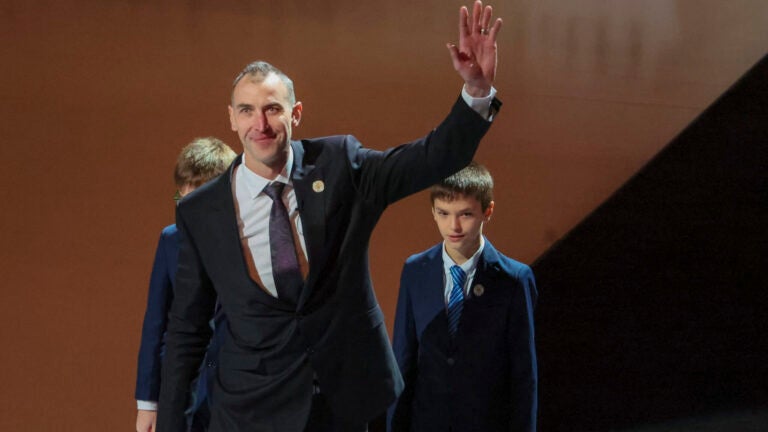
COMMENTARY
At first glance, it can be easy to size up a player like Zdeno Chara.
An imposing monolith on skates, the 6-foot-9 defenseman anchored Boston’s blue line for 14 seasons — using his frame to snuff out scoring chances and police the controlled chaos that spilled out on the ice, night in and night out.
But as former teammate Andrew Ference was quick to point out, it’s a dangerous game when it comes to sizing up a figure like Chara with a few preconceived notions.
“You think of Z — he’s a complicated guy,” Ference said Thursday of Chara. “Like, he’s not straightforward. A real-estate agent. He’s got his financial degrees. A very curious individual. Running his Ironmans and playing hockey. Even the hockey part’s complicated, right?”
Once a raw prospect whose potential was rooted in his gargantuan frame, Chara defied plenty of expectations on the way to hockey greatness.
The Slovakian product’s on-ice credentials speak for themselves.
Through 14 seasons with Boston — all with a “C” stitched onto his sweater — Chara was a steadying presence for a seemingly rudderless franchise. He played 1,023 games in Boston, scoring 148 goals and 333 assists while logging taxing minutes.
Along with a Norris Trophy — handed to the league’s top defenseman — in 2008-09, Chara finished top-five in voting for the annual award another eight times in his standout career.
He hoisted the Stanley Cup higher than it’s ever been before on June 15, 2011, while captaining Boston to another two Stanley Cup Final appearances in 2013 and 2019.
By the time he hung up his skates, he had appeared in the most games ever by a defenseman in NHL history, while his 14 Game 7 appearances are tied for the most in league history alongside his longtime Bruins teammate, Patrice Bergeron.
It came as little surprise last year when the 48-year-old Chara earned his call to the Hockey Hall of Fame in his first year of eligibility.
But just hours before the longtime Bruins captain became the 13th player to have his number raised to the Garden rafters, one sentiment was echoed by several Bruins greats.
There’s more than just meets the eye with a figure like Chara.
“With Z, it’s the ‘prove me wrong’ type of attitude that always stood out to me,” Bergeron said of his longtime teammate. “If you tell him he can’t do something, he’s going to make sure to do it.”
From shaking off the label of being nothing more than a big-bodied scrapper as a youngster to requesting the captaincy of a Bruins team seemingly mired in mediocrity in 2006, Chara has a long history of pushing himself into uncomfortable territory.
It’s the reason why the 42-year-old Bruins — just days after his jaw was broken by a deflected puck in the 2019 Stanley Cup Final — took to the ice in Game 5 of that series. His shattered maw wired shut and covered by a full face shield, Chara played the remainder of that championship series against St. Louis.
For Chara, that unflinching desire to beat the odds and defy limitations was rooted in fear, more than anything else.
“I played with fear of failing every game,” a candid Chara acknowledged Thursday. “And that pushed me to be playing with determination not to fail. I didn’t want to fail my teammates, my team, and so I kind of went into every game and pretty much every day just to prove and do your job and do your best. And that was my mentality.”
It was a mentality that — while channeled by Chara’s own fears — morphed into an infectious approach that helped re-establish the Bruins as a premier franchise in the NHL.
“I think they became the Bruins again,” Ray Bourque said of Chara’s impact after he signed with Boston in 2006. “I think we could be proud of that group and how they played. They played hard. They were hard to play against. … The fans really could appreciate that team and be proud of that team and that group.”
“He gave good speeches and ran good meetings, but he was the first one to do it, right? Good leaders are people of action,” Ference added. “And if he told you that you had to go 100 miles an hour, he would go 101 just to make sure that you knew that the ceiling was set.”
The tribute video that ran during Chara’s No. 33 retirement ceremony at TD Garden featured the expected highlights.
There was his booming slap shot at the 2012 NHL All-Star Skills competition — still standing as the fastest shot in NHL history at 108.8 miles per hour.
The TD Garden roared with approval of the various clips of Chara jettisoning skaters into glass, or turning David Koci’s forehead into prime rib with a few punishing haymakers.
There was the pirouette tally against Florida. The hat trick against Carolina. The embraces with his teammates after the triumphs (and tragedies) that played out on Causeway Street.
But it was fitting that Chara — the Bruins star who cultivated a culture of hard work, accountability, and inclusivity from his first day as captain — spent a majority of his speech on Thursday preaching the contributions of many, rather than reflect on his own achievements.
While musing about Boston’s first Stanley Cup title in 2011, Chara didn’t just salute the usual suspects from that roster like Bergeron, Tim Thomas, and Mark Recchi.
He instead made sure to mention every player from that roster — ensuring that each skater and netminder would get their appropriate applause from the Garden crowd.
It was a gesture that came as little surprise to Bruins, both past and present, who have shared a dressing room with the Hall of Famer.
“He legitimately made me better,” Ference said of playing alongside Chara. “And seeing north stars like him and a couple others that I played with — who show you the way to be a professional.
“And for an average guy like me. Like, that’s not to put myself down, but I was a pretty average player. I didn’t have an average career. And that’s because I followed guys like that and learned from guys like that.”
It’s a testament to Chara’s lasting impact that the culture he helped set down with the likes of Bergeron and Recchi has endured years after he last donned a black-and-gold sweater.
For David Pastrnak — once a shy teenager looking to find his footing in the NHL — Chara’s welcoming approach, banning of hazing, and the elimination of the term “rookie” in Boston’s room helped him find a home in short order with the Bruins.
That approach has remained intact and is more pertinent than ever as a retooling Bruins roster usher in more young skaters in the coming years.
“You try to make everyone comfortable in the locker room,” Pastrnak said Thursday. “And that’s what he made sure of, that everyone is comfortable in the room and feeling confident enough to speak up and have a voice. It’s a big credit to him. It helped me a lot and it’s something that’s in this locker room and I don’t think it will ever go away.”
Look no further than Jeremy Swayman for further evidence of Chara’s longstanding influence over this franchise.
As the final seconds ticked off the clock of Thursday’s 4-2 win over Seattle — Boston’s seventh win in its last eight games — Boston’s 27-year-old netminder pointed up to the rafters.
His target? Chara’s No. 33 — now lofted high over the ice alongside other pillars of the franchise like Orr, Bourque, and Shore.
“We want to be hanging right next to him one day,” Swayman said postgame, adding: “It’s bigger than us. He’s the one that paved the way for us. … We gotta earn [the fans’] respect every night, and he’s a big reason why we have that kind of a culture here.”
On a night where cheers of “Thank You Chara!” resonated across Boston’s barn, Swayman’s tribute was a fitting final display.
“That’s what legacy is about,” Chara said. “You want to hand it off, you want to have something that is left behind. … The new team, new generation, they got to find a way to lead their way. But I think what you kind of like to see is that culture being carried, right?
“Nobody’s going to be asking players to lead exactly the same way as I did, or Patrice did, or Brad did, or Ray did. But you want to be seeing those key fundamentals that are attached to those cultures and teams.”
And no player instilled that culture quite like Chara, who — much like his now-immortalized No. 33 — is forever woven into the fabric of a century-long institution.

Sign up for the Today newsletter
Get everything you need to know to start your day, delivered right to your inbox every morning.

