


Love Letters
Third wheeling has long had an undeserved bad reputation.

You’re reading Meredith Goldstein’s Love Letters newsletter. Each week, Meredith shares tales of human connection, thoughts on public policy and relationships, and behind-the-scenes stories about the Love Letters column and podcast. Sign up to get the dispatch.
Back in December, I asked Love Letters readers to tell me their thoughts on being a third wheel, and on the concept of third wheeldom, in general.
Third wheeling has long had a bad reputation. Many people believe that hanging out with a couple, as a single person, is bad, sad, pathetic, or simply unfun.
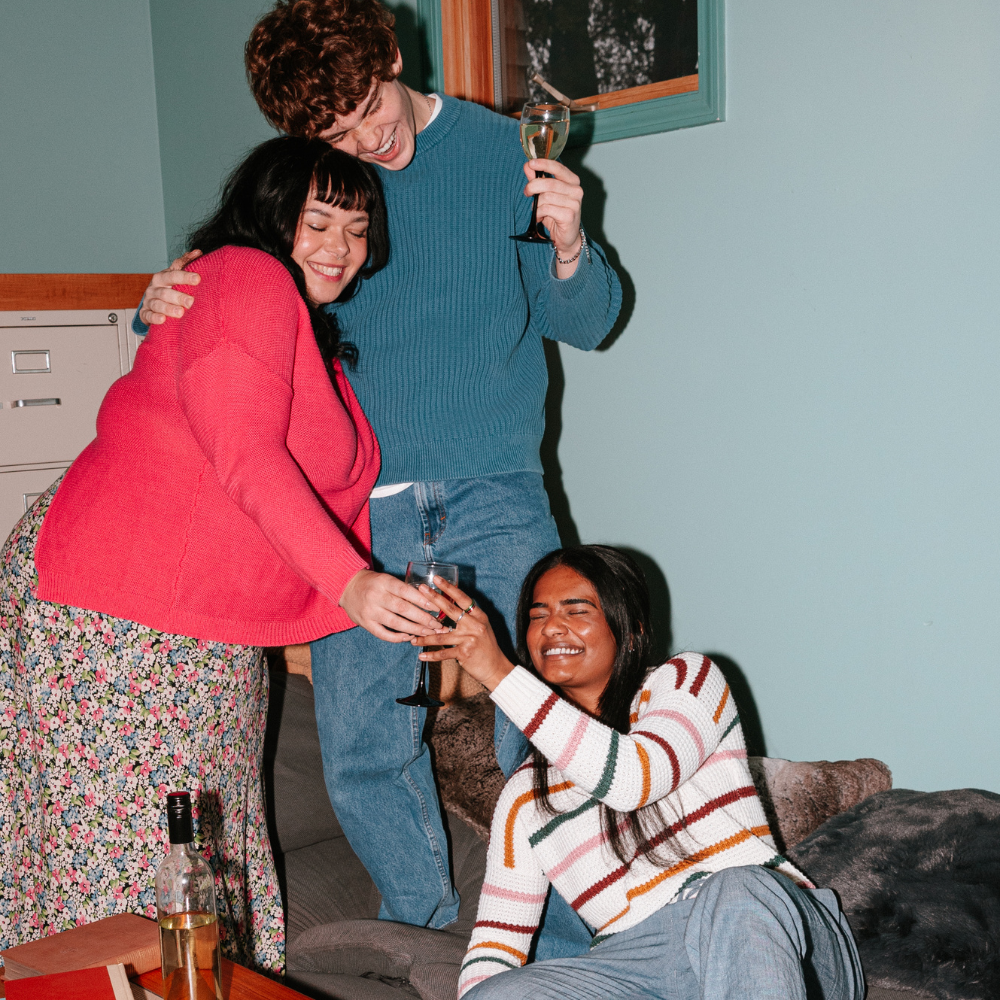
Based on my experience, though, third wheeling can be wonderful. Some of my happiest friendship memories were made when I was single and hanging out with a couple.
I’m ashamed to admit this – or perhaps not ashamed enough – but in my late 30s, I allowed the many couples in my life to dote on me like I was a child. They seemed to genuinely enjoy treating me like their special baby.
Sometimes they would cover my dinner because they were calculating what I like to call “couple math.” They’d say, “There are two of us and one of you; we might as well get the check.”
Go right ahead!
These wonderful couples asked me, frequently, whether I was comfortable with the temperature. They’d compliment me a lot, maybe because they feared I didn’t have enough validation in my life without a partner. (I didn’t require this, but it was nice.)
When any single person told me something like, “Ugh, this party is going to be all couples; I don’t want to go,” I’d think, “Am I missing something? That sounds like a pleasure.”
I do think I was a bit lucky – that the couples in my life were empathetic and respectful, and that as a single person I was in a good place to receive their attention. I wasn’t looking for romance at the time, so none of these relationships made me see a gap in my own life.
Many readers emailed me about their third wheel thoughts, and they were all over the map. Some said they loved being a non-sexual third. Others said it was annoying, and that the couples in their lives didn’t know how to make them feel seen.
The most common answer to the question went something like this: “I, a single person, would happily be the third or fifth person at dinner or on a vacation, but coupled people don’t invite me.”
In fact, we received a letter to the advice column about this very issue. A 70-something wrote to Love Letters saying she wishes she’d be invited to be a third and fifth wheel more often. She said, “I do notice that when it is something including spouses – theater, travel, etc. – it can be awkward, so I am not invited. I have made my peace with that, but it is hard at times to feel ‘left out’ even at my age.”
Why don’t couples invite singles to do things?
I talked to some experts about this, hoping to make sense of the history of third wheeldom and why it can be so difficult.
Elaine Hoan, a fourth-year PhD student at the University of Toronto, isn’t an expert in third wheels, specifically, but she focuses her work on relationships, singledom, and happiness. One of her recent studies examined the experience of being single, depending on one’s gender. (Turns out, women like being single more than men. Pretend to be shocked!)
I started my interview with Hoan by asking the wrong question: “Do single people avoid hanging out with couples because they think their coupled friends are bad company, or is it that they fear the stigma of being a third wheel?”
Hoan said, according to the research, it might actually be the opposite — it’s probably the couples that avoid the singles. “Couples engage in this thing called cocooning, and this is an actual term where, especially in the beginning … they tend to spend a lot of their time with just one another and almost essentially go MIA.”
Research on couples has shown that “adding a romantic partner into a person’s network almost displaces one close friend and one family member, on average,” Hoan said.
She agreed that couples might benefit from remembering that other people exist – and not just other couples. Perhaps they’d be more likely to experience the social pleasures that single people seem to love.
During our conversation, Hoan cited the work of Jaimie Arona Krems, who helms the UCLA Center for Friendship Research. It should be no surprise that as a relationship journalist, I want to read everything Krems writes because she and her colleagues are reframing – in very important ways – how we study human bonds. So much work by researchers has focused on couples and families, but many people have entire networks built around close friendships.
Krems told me that when it comes to third wheeling, and couples not seeking one friend to share their time with, it might go back to something known as the “perception gap.”
Krems said these gaps are very relevant when it comes to friendships. She mentioned work by researchers such as Hasagani Tissera who have learned that people jump to the conclusion that others do not want their company.
“So when we meet,” Krems explained, “I might think that you like me less than you do, and I might also think that you like me less than I like you.”
That makes us all unlikely to pick up a phone and say, “Hey, let’s do something cool together.”
Krems herself is studying perception gaps around helping. Meaning, some people believe that if they ask for help, they’re burdening their friends. In reality, many of those friends are honored and thrilled to be asked because they feel special and loved for being trusted.
Krems said when it comes to third wheels, it’s possible that couples aren’t asking singles to hang out because they’re thinking, “Why would that person want to spend time with us?”
But Krems said she doesn’t actually know what’s at play with couples, singles, and the misunderstood experience of the third wheel. She told me that as far as she knows, third wheeling hasn’t been studied.
That makes her want to study it, which makes me very happy.
She said that if couples were more open to bringing a single into their unit, friendship, in general, might be easier. After all, how likely is it that everyone on a double date is going to adore each other?
“Couples [making] ‘couples friends’ have to overcome hurdles of a lot of different [layers of] ‘liking.’ It is not easy. It should be easier to have couples with single friends than couples and ‘couple friends’ simply because there are fewer people that have to like each other.”
If a couple finds a single who loves both parties, it should be a ‘beautiful marriage,’ in its own way, she said.
“Why does it not exist [more]? Well, it probably doesn’t exist because couples think the single doesn’t want to hang out with them.”
This is where I can say: Love Letters has an entire new podcast episode devoted to exploring the concept of third wheels. It’s about how you can get turned off to these relationships when you’re young, because when you’re a teen hanging out with a new couple, you can feel very ignored.
I explain how the quality of third wheeling experiences can improve with age.
We also tell one specific story about my recently divorced sister finding a pack of coupled friends in her new hometown. She and I examine what makes these relationships work, and what surprises her about them.
She also gets honest about how third wheeling with two gay men is different from bonding with a straight couple. She wishes it weren’t true, but the boundaries feel more complicated.
We also hear from one couple who considers my sister their first real third wheel ever, and they love her for it. Their experience highlights how healthy it can be for couples to share a friend – that having one person who loves you and your partner equally can strengthen your bond.
We also define “third wheel” as a concept in this episode, because to me, being a Third Wheel, in the best way, means you’re a person who loves a couple, and that couple loves you back. Hanging out with a friend’s spouse who you know a little – or simply tolerate – … that’s something else.
A coupled person in this episode has a great line about rethinking third wheels, one that gets to the heart of what we learn. I’ll leave it here.
“As I’m getting older, I’m seeing a lot of people, um, riding on the bike trails here with e-trikes. I am thinking, you know, a third wheel actually adds stability and balance. And so, you know, it, it comes off almost like a negative term, a third wheel. But in reality, a third wheel can add balance and safety.”
You can find the episode wherever you get podcasts.
Please remember, we are always on a quest to figure out how to have happy relationships. It helps when you tell us what’s going on in your world. Having any problems or confusions about your most important relationships? Crushes? Mixed signals? Hopes and dreams? Send your question to [email protected] or use this anonymous form.
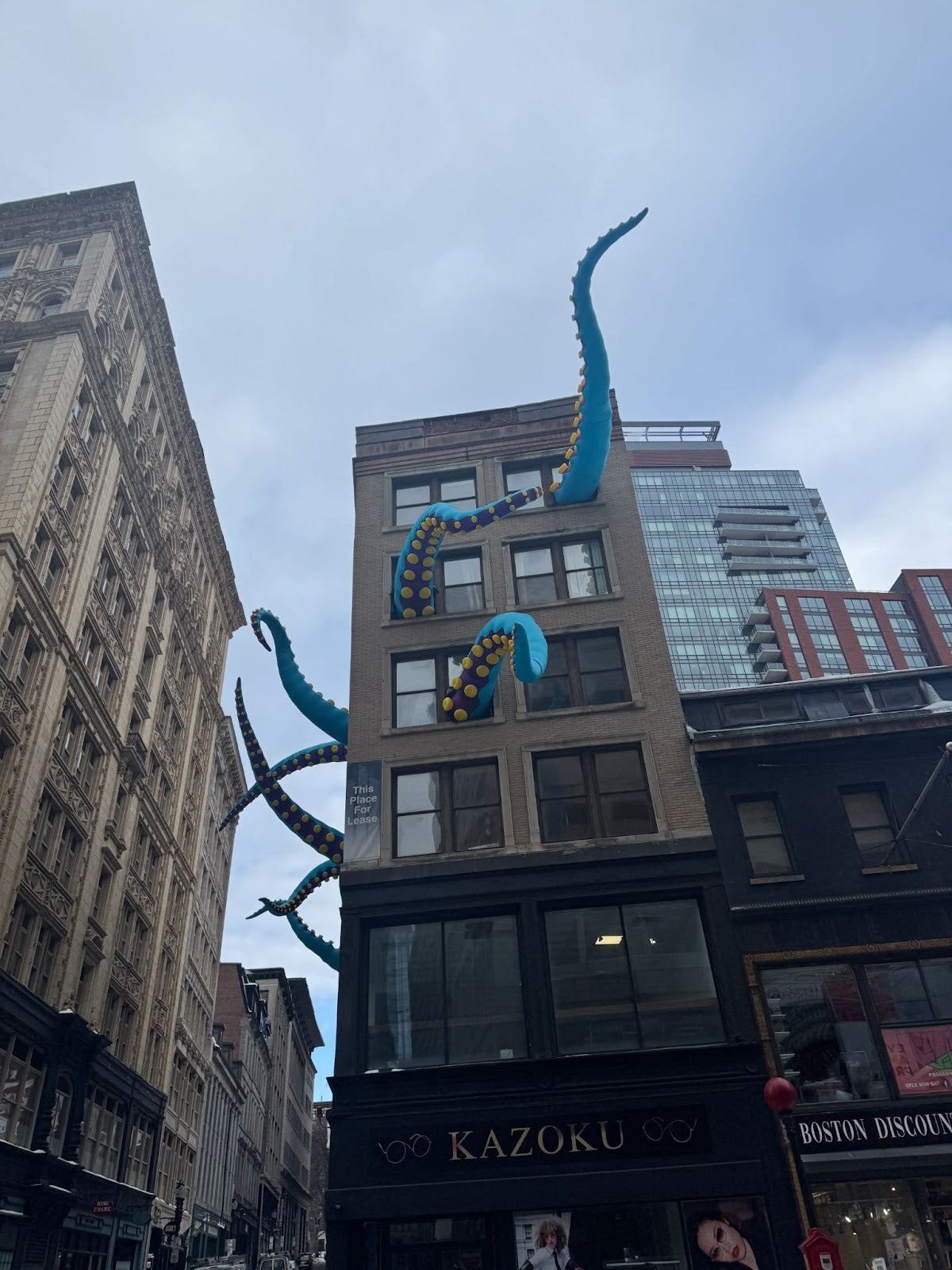
All arms
I’ll leave you with a photo I took on the way to work. Boston has winter installations that look playful or horrific depending on the light. I’ll let you decide which category this one falls into.
— Meredith

Get a little love in your inbox!
Sign up for the Love Letters newsletter for announcements, hand-picked letters, and other great updates from the desk of Meredith Goldstein

