


Commentary
From anxiety over loved ones abroad to public demonstrations, Boston-area residents are confronting the human and political fallout of the strike that killed Iran’s supreme leader.
Every morning, Bahar Sharafi wakes up and checks to see if the Iran neighborhood where her family lives has been hit. Then she waits for her mother’s call.
“This is a difficult time for me,” Sharafi, a Boston-based Iranian-American activist, told Boston.com. “It is very difficult to see just a lot of places that I love being destroyed [and] neighborhoods being bombed.”
Sharafi is not alone in her anxiety.
Following the U.S.-Israeli strike in Iran on Saturday that killed Supreme Leader Ayatollah Ali Khamenei and sparked a war, many in Boston and the greater Massachusetts area are grappling with shock and fear.
Sharafi said her friends with family in Iran are worried and horrified.
“The stress of it is so much,” she added. “I think a lot of people are not ready to be mobilized or to be planning and thinking about what is next and what to do — just watching in horror.”
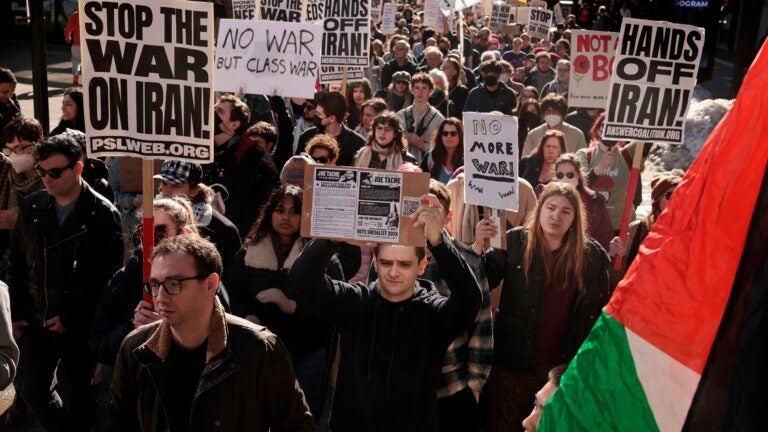
Protests and demonstrations erupted across Boston in response.
On Saturday, demonstrators gathered in Copley Square to support the military campaign, while less than a mile away on Boston Common, another crowd denounced the attacks as illegal. Another Boston Common protest took place Monday to protest the war.
Boston Democratic Socialists of America helped organize Monday’s protest. Communications Director Joe Whitcomb said the protest aimed to channel public concern into action.
“More importantly, it’s to show to the American public and to the world that there are Americans and people within this country that don’t want this kind of escalation and this kind of violence,” he added.
U.S. Senate candidate Joe Tache, representing the Party for Socialism and Liberation, attended Monday’s protest. He said it was crucial to demonstrate public opposition and expand the anti-war movement.
“This war is already disastrous, and it’s only going to get more disastrous — both for the people of the United States and for Iran,” Tache said.
The majority of American citizens do not support the war in Iran, according to a poll conducted by CNN this week.
Tache said he opposes the war due to the financial and human cost, arguing that wartime spending could instead support health care, housing, and education.
“It’s not about making life better for the people of Iran. It’s not about making the world safer,” he said. “It’s really about the elites who control politics in this country, trying to dominate countries abroad and sacrificing lives and sacrificing our tax dollars to establish a domination.”
Jeff Klein, a Dorchester resident, has served on the board of Massachusetts Peace Action (MAPA) for 10 years. Klein said he has traveled frequently to the Middle East and said the protests were necessary because the U.S. initiation of the war was illegal.
“It’s illegal for a country to attack another country militarily except in self defense,” he said, citing the United Nations Charter.
Klein also noted that under the U.S. Constitution, only Congress can declare war — not the president.

“There’s no legal or moral justification for it,” he said. “Our democracy is not functioning very well when the president can act individually on some kind of whim, contrary to what American people want, which is not more war.”
MAPA continues to support congressional efforts to pass war powers legislation that would withdraw presidential authorization for the conflict, Klein said. He highlighted Senate Joint Resolution 104, co-sponsored by Massachusetts Senators Ed Markey and Elizabeth Warren, which aims to direct the removal of U.S. armed forces from unauthorized hostilities in Iran.
“It’s kind of a long shot, given the Republicans in the Congress who will support anything that Trump does,” he said. “But you have to … be determinant. You have to say no.”
Sharafi stressed that public pressure on Congress, especially the current resolution, is crucial.
“It is their duty, and the American people need to hold their feet to the fire,” she said.
Sharafi said the public needs to become educated on the conflict.
“They should talk to their representatives and demand that they condemn attacks on Iran and especially the attacks on Iranian civilians,” she said.
Members of Veterans for Peace also joined in on the protest. Joe Kerbartas, a 77-year-old Vietnam War veteran and South Boston resident, has been involved in anti-war activism for decades. He emphasized the financial costs, human toll, and ongoing cycle of U.S. military interventions in the Middle East.
“The U.S. is almost addicted to war,” he said. “Everytime you turn around, there’s another one.”
“It’s a sad commentary about how the United States has just gone from one war to the other, and [it’s] the only way we stop things,” he added. “That’s why people are out in the street. People are angry, and we have to get a large number of people to [show] how much damage this war is doing to the United States itself.”
Kerbartas said the local Iranian community could be affected by the prejudices that often follow war. He recalled how Japanese Americans were placed in internment camps during World War II and Germans faced persecution in the U.S. after World War I.
Kerbartas said he has Iranian friends living in the U.S. who are afraid to go outside. He noted that, like after 9/11 when many Muslims faced discrimination, the community could face similar challenges now.
Sharafi said she is less worried about prejudice for now because many Americans oppose the war — but she said public opinion about Iranians could shift as the conflict continues.
“I’m 77 years old, and I’ve looked back and thought I lived a great life,” Kerbartas said. “But the future, I’m scared for.”
Do you support the US strikes on Iran?
Sign up for the Today newsletter
Get everything you need to know to start your day, delivered right to your inbox every morning.

