


Local News
2025’s 31 homicides is still the lowest in the last two decades, excluding 2024, Boston Police Commissioner Michael Cox said.
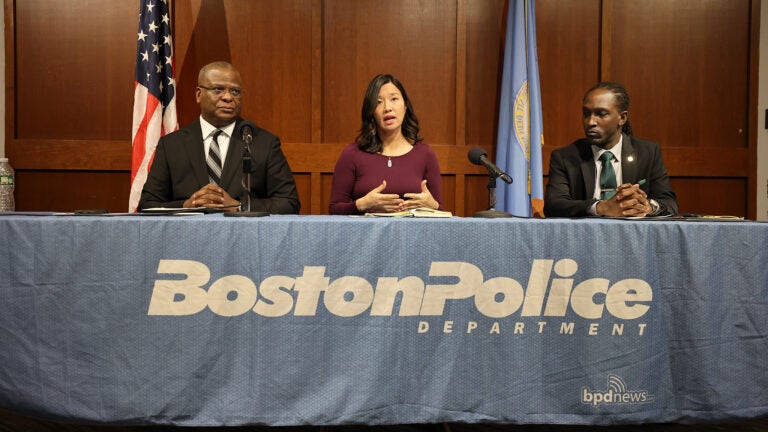
Mayor Michelle Wu once again touted Boston as the “safest major city in the country” after 31 people were murdered in Boston in 2025, a 30 percent increase from the city’s historically low 24 homicides the previous year.
“This is what it means to be a home for everyone and to be fighting every day for the residents in every single neighborhood to live in the safest city in America, the best city for families,” Wu said during a public safety update last month.
The 31 homicides mark a 16 percent decrease from Boston’s five-year average, Boston Police Commissioner Michael Cox said during the same press conference. The 31 homicides in 2025 is still the lowest in the last two decades, excluding 2024.
Three of the 31 homicides took place in previous years but were declared homicides in 2025, according to the data released by Boston police. In 2024, one of the 24 homicides were from prior years.
Despite the increase in homicides, violent crime overall is trending downward, Cox said, around downtown and the area of Melnea Cass Boulevard and Massachusetts Avenue. Most violent crimes are below the city’s five-year averages with the exception of domestic aggravated assault, according to crime statistics released by the department.
Of the 31 homicides, 19 were victims of gun violence, according to Boston police crime statistics. More than 100 people were shot in Boston in 2025 and survived.
Ruth Zakarin, the CEO of the Massachusetts Coalition to Prevent Gun Violence, said her organization works with state partners and local advocates to address gun violence as “a public health crisis.”
“It is good to get the numbers lower for sure, (but) the numbers don’t tell the full story of the trauma of gun violence,” Zakarin said. “Every shooting is both a crisis and a call to action, and 24 homicides means that 24 families are left bereaved. Twenty-four communities are left traumatized, so there’s a lot of nuance to this conversation.”
Zakarin said her organization works at the state level.
“We really have to think about anything happening in Boston as being regional, some of the homicides that have happened outside of Boston have had folks from Boston involved,” Zakarin said, “so whether it’s Randolph or Brockton or Lynn or Lawrence, it is a regional issue.”
Isaac Yablo, the city’s senior advisor for community safety and the Boston Public Health Commission’s director of the office of violence prevention, said the Community Healing and Response Network and Violence Intervention and Prevention (VIP) Initiative both have expanded across the city.
“Our VIP initiative has shifted from focusing solely on five communities to a city wide focus, so that more residents are being met where they’re at, and that we’re addressing needs more holistically,” Yablo said. “We will continue focusing on secondary and tertiary prevention, but the main goal will be primary prevention, preventing the violence from happening in the first place.”

Sign up for the Today newsletter
Get everything you need to know to start your day, delivered right to your inbox every morning.

