


Boston Bruins
“We’re going to change [it] a little bit moving forward.”
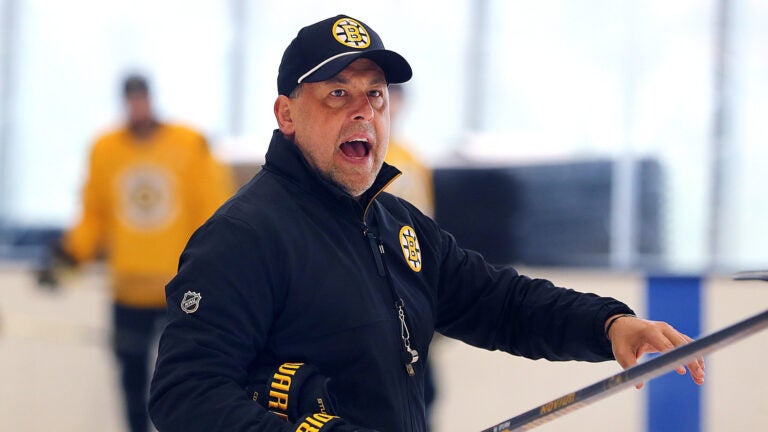
The 2025-26 Bruins have exceeded plenty of expectations so far this season.
For all of the talk of Boston embracing another “bridge” campaign under first-year head coach Marco Sturm, the Bruins entered the three-week Olympic break in a playoff spot with a record of 32-20-5.
They’re currently in the second wild-card spot in the Eastern Conference — four points clear of the Blue Jackets — and are just three points out of second place in the Atlantic Division.
A 12-2-3 showing since a lopsided win over the Oilers on New Year’s Eve has Boston operating with a bit of breathing room in a compacted Eastern Conference.
But a return to the postseason is far from a given for Sturm’s pugnacious crew, not with Boston set to sprint to the finish line with 25 games to play in the span of 48 days — starting with a bout with said Blue Jackets on Feb. 27.
If the Bruins want to cement their standing in the East’s playoff picture, Sturm and his staff still need to finetune a few things to ensure Boston hits the ice running later this month.
It came as little surprise what stood at the top of Sturm’s to-do list during Boston’s break.
“Probably the biggest thing is PK,” Sturm said Wednesday of Boston’s top focus during the club’s downtime. “We’re going to change [it] a little bit moving forward. I think over the break, that was our biggest homework.”
Assistant coach Steve Spott should frankly be in the running to take home the 7th Player Award as Boston’s unsung hero — given his role in sparking the Bruins’ once-dormant power play this season.
After ranking 29th in the NHL last season on the man advantage (15.2 percent), the Bruins have cashed in on 26.3 percent of their power-play bids in 2025-26 — good for third in the league.
That surge in special-team production hasn’t exactly translated over to the penalty kill however.
So far this season, the Bruins have only negated 76.4 percent of opposing power plays — ranking just 28th overall in the NHL.
It stands as a stark regression for a Bruins team whose success over the years has been rooted in flipping the ice and snatching momentum during special-teams reps.
Boston’s porous PK play has been especially evident since the calendar flipped to 2026.
The Bruins have only lost two games in regulation over their last 16 bouts, but over that stretch they’ve only killed off 64.8 percent of opposing power plays. Only the Vancouver Canucks (sporting a hideous 56.1 percent PK percentage) have been worse over that same stretch.
Boston has shown all year that they can dole out damage on the power play. At 5-on-5 action, they’ve kept things competitive, even if their underlying numbers are a bit more concerning (their 5-on-5 expected goals percentage of 46.5 percent ranks 28th in the NHL).
But the Bruins can’t keep accruing points at a steady clip if opponents continue to deliver a few haymakers whenever a black-and-gold sweater in marinating in the sin bin.
Granted, an extended layoff might be just what the Bruins’ shorthanded crew needed at this stage of the NHL calendar.
After all, Boston’s go-to killers like Nikita Zadorov, Sean Kuraly, Fraser Minten, Mark Kastelic, and others were likely running on fumes due to the Bruins’ propensity for ending up in the penalty box.
As steady as Boston’s PK was in the early going of the 2025-26, it should come as little surprise that the Bruins’ D-zone fortitude waned on a team that ranks second in the league in penalty minutes per game (13.5).
“First of all, we take way too many penalties. We all know that,” Sturm noted. “We have to get better. That’s just the bottom line. We just have to.”
The Bruins’ inability to get out of its own way with its discipline issues has led to a devastating domino effect at times.
Time spent killing penalties saps the ice time afforded to Boston’s top offensive weapons like David Pastrnak and Morgan Geekie. It saps momentum that the Bruins have regularly seized at even-strength action.
And it taxes an already exhausted Bruins shorthanded unit that — based on its personnel alone — should be far better than a bottom-five grouping across the NHL.
Be it cleaning up those ill-timed stick infractions or augmenting Boston’s shorthanded structure, the Bruins need to find a proper remedy to at least alleviate the team’s most-glaring flaw before the stakes grow even higher this spring.
“We just couldn’t handle it, and we didn’t have the answer,” Sturm said of opposing power plays adjusting to Boston as the season carried on. “And also, we were taking way too many [penalties], and all of a sudden it was a little bit of a downfall.
“So again, we try to have something in place right now that hopefully fits our group and players better. Remember when I said five-on-five game, the way I want to play is not for everyone. So, you got to fit the right group and the right players. And I think hopefully the PK, it’s going to help us to fit the guys we have right now.”

Sign up for the Today newsletter
Get everything you need to know to start your day, delivered right to your inbox every morning.
