


National News
“Many are barely holding on mentally, emotionally, and financially. To pretend otherwise is a lie.”
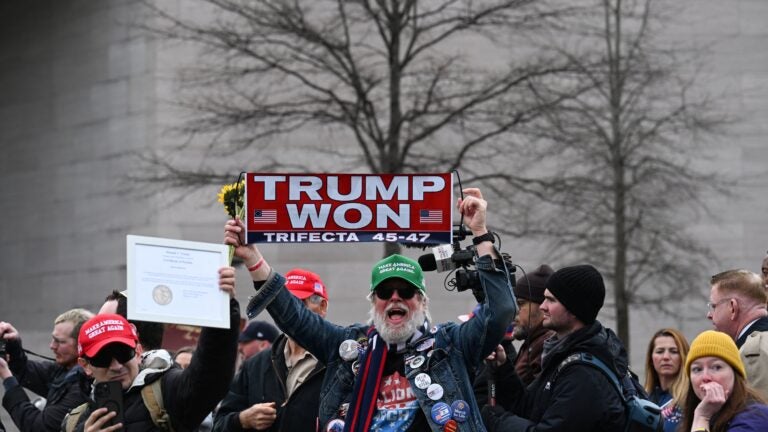
In the first hours of his second administration, President Donald Trump sought to wipe away all trace of the attack on the Capitol by granting amnesty to nearly 1,600 people implicated in the riot stoked by his lies about a stolen election.
They answered with a collective cry of gratitude. And why not?
The pardon proclamation saved them, opening prison doors and ending all of the criminal prosecutions related to the Capitol attack. Even more, it gave a presidential stamp of approval to their inverted vision of Jan. 6, 2021: that those who assaulted the police and vandalized the historic building that day were victims, and those who spent the next four years using the criminal justice system to hold them accountable were villains.
But nearly a year after Trump’s sweeping proclamation asserted that he had cleared the way for “a process of national reconciliation,” many recipients of his clemency remain consumed by conspiracy theories, angry at the Trump administration for not validating their insistence that the Capitol attack was a deep-state setup and haunted by problems from both before and after the riot.
“Being pardoned doesn’t make these families whole,” Cynthia Hughes, a prominent advocate for the Jan. 6 defendants, wrote on social media recently. “Many are barely holding on mentally, emotionally, and financially. To pretend otherwise is a lie.”
In the five years since the Capitol was stormed, no new facts have emerged to undermine the basic findings of congressional and Justice Department investigators that many of the rioters acted in the misguided belief, pushed relentlessly by Trump, that he had been robbed of victory in 2020 — and that in attacking the Capitol they not only injured about 140 police officers but also struck at a cornerstone of American democracy: the peaceful transfer of presidential power.
Even so, Trump has long maintained that the rioters endured horrible, even illegal, mistreatment during their prosecutions.
And yet if that is true, some pardoned rioters are now asking, then why haven’t their persecutors been thrown in jail? And if the rioters are martyrs to a righteous cause, as the president and his allies have often said, then why haven’t they been made whole through financial reparations?
While this disillusionment is not universal, some so-called J6ers have even begun to ask why, after nearly a year in power, Trump’s law enforcement agencies have yet to provide any proof of the conspiracy theory they promoted to help him reclaim the presidency: that deep-state agents lured Trump supporters into storming the Capitol to derail the MAGA movement and justify political reprisals.
What J6ers rarely seem to acknowledge is the possibility that Trump’s government has failed to reveal the hidden truth about Jan. 6 because there is no hidden truth, no deep-state conspiracy, and therefore no legal reason to bring further charges related to the riot.
Still, their questions have nurtured new conspiracy theories from the old, focused not on the Biden administration, but on those in power now, Trump loyalists like FBI Director Kash Patel and Attorney General Pam Bondi. The theories have intensified as the fifth anniversary of Jan. 6 has arrived — a milestone that many rioters believe marks the final chance to punish the shadowy government agents who supposedly entrapped them in what they have come to call the “fedsurrection.”
“If the true perpetrators of Jan. 6 aren’t held accountable before the statute of limitations expires on Jan. 6, 2026, count me OUT of the midterms,” Shane Jenkins, whose several felony convictions for Jan. 6 included assaulting law enforcement, wrote last month. “I’ll be running AGAINST the GOP.”
By feeding a steady diet of unfounded conspiracy theories not only to the J6ers but also to others in their base, Trump and his allies have spawned what some experts have likened to a zombie army of followers. And now, by failing to follow these theories to their logical conclusions, they are seeing that army begin to turn on them.
“When you’re told day after day that you’re a victim — when you’re told that for four years straight — it sinks in,” said Jon Lewis, a research fellow with the Program on Extremism at George Washington University. “They’ve become conspiratorial-minded people looking for the next thing to mobilize for.”
“There’s this zombie specter of Jan. 6 defendants who are just looking for that red meat,” Lewis added.
Another conspiracy theory takes hold
All of this was on display at the end of the year, when many pardoned rioters reacted in fury as competing solutions were offered to an enduring mystery arising from the Capitol attack: Who planted pipe bombs outside the Republican and Democratic Party headquarters on the night before Jan. 6?
The first answer was put forward in early November, when Steve Baker, one of the rioters, published an article in the right-wing news outlet The Blaze, saying he had found a “forensic match” between the hooded suspect caught on video prowling Capitol Hill that night and a former Capitol Police officer who had fought the mob on Jan. 6 and then went to work for the CIA. Baker’s report fit neatly into the “fedsurrection” narrative, linking the bombs to a former law enforcement official with ties to the country’s premier intelligence agency.
But The Blaze scoop fell flat. Federal officials, including Dan Bongino, the deputy director of the FBI, dismissed it as untrue, and the former officer’s lawyers said that when the suspect was supposedly setting the bombs, their client was home, playing with her dogs.
A couple of weeks later, Bongino, Patel and Bondi stood side by side at the Justice Department to announce their own break in the case — one that contradicted Baker’s. Federal agents, they said, had just arrested Brian Cole Jr., a Virginia man who would later tell the FBI he had planted the bombs because he wanted to “speak up” for those who believed the 2020 election had been stolen.
Bongino, who led the bureau’s investigation, used the news conference to flatter Trump, saying the arrest would not have happened without the president’s demands “to go get the bad guys.”
But Bongino left out something important. He never mentioned that before joining the FBI, when he was a right-wing podcaster, he had embraced a view of the investigation that echoed the one promoted by Baker: that the pipe bomb case was an “inside job” that the bureau itself had obscured in a “massive cover-up” intended to stop Republicans from questioning the 2020 election.
Hours later, he minimized that contradiction when pressed on TV by Fox News host Sean Hannity.
“I was paid in the past, Sean, for my opinions, that’s clear, and one day I will be back in that space — but that’s not what I’m paid for now,” said Bongino, who two weeks later announced his resignation from the FBI. “I’m paid to be your deputy director, and we base investigations on facts.”
But the arrest of Cole had already planted another conspiracy theory in the collective mind of the Jan. 6 community.
Several rioters quickly described the FBI’s suspect as a patsy whose arrest was meant to distract from the truth that the real culprit, the former officer identified by Baker, was still at large. Some armchair anatomists argued that Cole’s legs were too short for him to have been the hooded suspect in the surveillance videos.
There was even talk of a government cover-up. A new cover-up, not the old one promoted by Bongino.
Pardoned rioters seized on the fact that the prosecutor managing the pipe bomb case, Jocelyn Ballantine, had also overseen another high-profile Jan. 6 case: that of Enrique Tarrio and other leaders of the far-right Proud Boys, who were convicted of seditious conspiracy, only to be granted clemency and freed by Trump.
This new conspiracy theory went viral enough to be featured days later at a media event with Trump at the White House. The president was asked about Ballantine by one of the White House press corps’ newest members, a correspondent for LindellTV, a company created by Mike Lindell, the election denier and founder of MyPillow.
There was no reason to believe Trump had ever heard of Ballantine, whose experience handling many complex Jan. 6 prosecutions made her a natural fit to oversee the pipe bomb case. But that did not stop him from casting suspicion on her.
“Jocelyn is being looked at — they all have to be looked at,” Trump said. “What they’re doing is so bad. This was a whole Democrat hoax.”
Though his answer promised nothing, it still gave oxygen to the question’s conspiratorial premise. It also gave pardoned rioters another reason to turn against the Trump officials they once believed would reveal the truth about the case.
In an interview shortly after Trump was asked about Ballantine, Tarrio said he was pleased that the issue was on the president’s “radar,” but expressed skepticism that anything would come of it.
“We might see some results from it,” he said. “But I don’t trust the DOJ whatsoever to do the right thing here. I mean they’ve fumbled everything.”
Restitution for the riot
For many Jan. 6 defendants, clemency was not enough. From the moment Trump issued his proclamation, there came demands for more: deep-state actors held accountable, hidden truths revealed and reparations — some form of monetary apology — paid.
Nearly two months after Trump’s decree, lawyers representing Jan. 6 offenders were making plans to sue the Justice Department. They intended to argue that the cases stemming from the Capitol attack amounted to malicious prosecution and that many rioters had been grievously harmed by their own government.
Two lawyers were behind the effort: Mark McCloskey, known for brandishing a semiautomatic rifle in 2020 as Black Lives Matter protesters paraded past his home in St. Louis, and Peter Ticktin, a friend of Trump since their teenage years at the New York Military Academy.
The men had reason for hope. Asked in the spring about possible compensation for the rioters in an interview on the right-wing news channel Newsmax, Trump gave a typically opaque answer.
“A lot of people that are in government now talk about it because a lot of the people in government really like that group of people,” he said.
But there is a yawning chasm between talk and action — especially in Washington. And recognizing the hurdles to winning lawsuits against the government, McCloskey began pitching top Justice Department officials on a more audacious plan, establishing a panel to award damages to the rioters, similar to the special master who distributed money to victims of the Sept. 11, 2001, terrorist attacks.
One of McCloskey’s top interlocutors was Ed Martin, who has a history of espousing conspiracy theories and raising money for the Jan. 6 offenders. Martin, who ran the U.S. attorney’s office in Washington until May, now leads the Justice Department’s weaponization working group, whose stated mission is to review the actions of law enforcement officials who investigated Trump.
But as the first year of Trump’s second term drew to a close, McCloskey’s proposal was in limbo. It was not lost on many pardoned rioters that Trump himself had demanded that the Justice Department pay him up to $230 million in similar claims for the criminal inquiries it conducted into him.
Last month, in a tacit admission that his negotiations had stalled, McCloskey posted a photo of himself on social media wheeling a cartload of boxes to Justice Department headquarters. The post said the boxes contained hundreds of government forms filled out by would-be litigants in advance of filing claims.
In an interview with The New York Times, McCloskey said that while he and Martin had held a number of “positive meetings,” Trump and his administration appeared to have “no appetite” at the moment for financially compensating the rioters.
His photo, he said, was meant to warn that lawsuits could be coming.
“I don’t think any word has come down from on top about how to handle these things,” McCloskey said. “But we want to give them a wake-up call, saying, ‘This is a problem you should probably stop ignoring.’”
A milestone on several fronts
Five years later, the Capitol attack continues to define many of its participants. Whether in triumphant or sorrowful commemoration, some are planning to return to Washington for the fifth anniversary to rewalk the path that changed their lives.
“January 6 didn’t end when the sun went down,” Tommy Tatum, whose civil disorder charges were dismissed by Trump’s clemency proclamation, wrote in a post last month titled “I’m Still Going to Washington.”
“For many of us, it never ended at all,” Tatum said. “It followed us home. It sat with us in courtrooms, hospitals, quiet rooms, and sleepless nights.”
But the anniversary also marks the day the five-year statute of limitations will expire for crimes arising from Jan. 6 — chief among them the supposed offenses that the conspiracy-minded believe were committed by the government that day.
“President Trump campaigned on there being feds in the crowd that stirred up trouble, but we haven’t seen any action against them yet,” said Will Pope, one of the rioters. “The bottom line is we’d like to see some action.”
Demands for vengeance from rioters like Pope, while neither sudden nor surprising, have long been fanned by Trump and some of his top aides.
But the insistence by many J6ers that time was running out to seek charges against federal instigators, prosecutors who worked on their cases and even members of the congressional committee that investigated the Capitol attack created such a drumbeat that top Justice Department officials felt compelled to address it.
On the Sunday after Christmas, Harmeet K. Dhillon, the head of the department’s civil rights division, attacked the “influencers” who were raising questions about the statute of limitations, effectively telling them not to worry. The “Trump/Bondi DOJ,” she vowed, “is working to bring to justice those who weaponized January 6th, 2021.”
One way such justice might be meted out is through a report that Martin has been preparing on the government’s response to Jan. 6. The effort is being coordinated in part by someone who joined in the Capitol attack: Jared L. Wise, a former FBI agent who was charged with encouraging the mob to kill the police that day and then, after receiving clemency, was hired by Martin as a Justice Department adviser.
While it remains unclear what the report might say, Wise has met about it with officials in the White House and the deputy attorney general’s office, according to internal Justice Department records. Some rioters have shared their own perspectives with his team, Reuters recently reported, and have even suggested how to shape indictments against the very officials who sought to hold them accountable.
Treniss Evans, who was sentenced to 20 days in prison after pleading guilty to entering the Capitol, sent a statement to the Justice Department last year that outlined how, in his opinion, charges could be filed against some of the agents, prosecutors and even judges who handled Jan. 6-related cases for what he described as having concealed exculpatory evidence and suborned perjury from witnesses. He volunteered to take the witness stand if new charges were filed.
It is impossible to know whether Trump’s Justice Department would, or even could, follow through on such charges. While Martin is said to have the president’s ear, several of his more aggressive plans have been shelved by his Justice Department superiors, including the deputy attorney general, Todd Blanche.
Many police officers injured protecting the Capitol on Jan. 6 still bear scars from that day. And many agents and prosecutors who worked on riot cases — some of whom were fired for it — seem outraged that the defendants have come after them but unsurprised that they have failed to get the charges they have asked for.
“It almost reminds me of a cult leader not delivering to his followers,” said Mike Romano, a former prosecutor who worked on Jan. 6 cases. “Maybe the leader never intended to or never had the power to deliver.”
Still, the calls for revenge among the pardoned rioters and their supporters remain loud and impatient. Some have expressed resentment that other news has sucked right-wing attention away from their cause, including, most recently, disgraced financier Jeffrey Epstein.
“America is obsessing over Epstein while the January 6 victims — REAL victims — are being erased,” Hughes, the ardent supporter of the rioters, wrote in one recent post. “These are Americans who were thrown into solitary confinement for YEARS, denied Due Process, raided, bankrupted, and separated from their children. Families destroyed. Lives shattered. And now? Silence.”
Hughes is hardly alone in her frustration. The repeated intimations by Martin and others that the perpetrators of the “fedsurrection” will be brought to justice — without, as yet, any conclusive action — have fueled suspicion about who is in cahoots with whom.
In other words, an even grander conspiracy.
Geri Perna, whose nephew died by suicide while awaiting sentencing in a riot case, posted an image on social media shortly before Christmas that seemed to capture the fierce desire and waning hope for retribution. It depicted Santa Claus shouldering a bag of gifts, each wrapped in a red bow and labeled with a single word: ARRESTS.
“Dear Santa,” her caption read. “We’ve been waiting patiently all year.”
This article originally appeared in The New York Times.
Boston.com Tonight
Sign up to receive the latest headlines in your inbox, every night.

