


Sports News
“If we had an Olympics, the center of Boston would be the focus of the Olympic Games.”
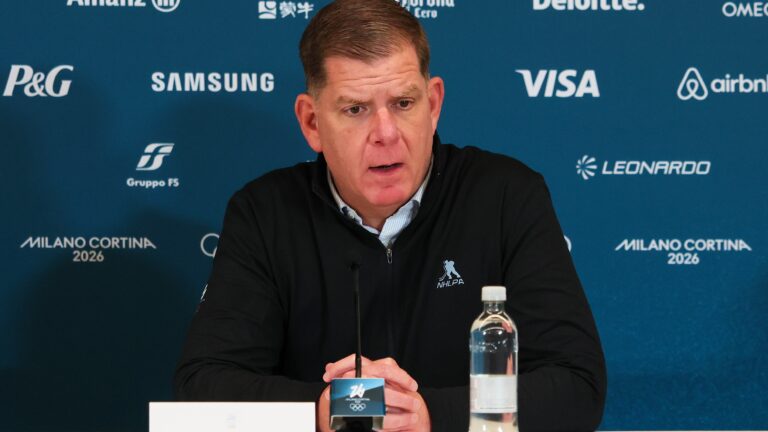
MILAN — Here in Italy, Marty Walsh saw the vision he couldn’t achieve laid out to great success.
These Olympics were the most widespread ever. Two host cities, two cauldrons, multiple opening ceremonies. The intent was to maximize existing venues, lessening the burden on a city to encourage more hosts and make it more likely for athletes to perform their best.
It wasn’t perfect, but it certainly worked. Travel delays in the mountains because of snow and backed-up buses were expected and unfortunate, but that’s part of the experience. The handful of temporary venues were fine for the most part, if a bit hard to get to. And Santagiulia Ice Hockey Arena was finished enough to host some excellent games (Just don’t look too closely at the concrete finishes in the basement).
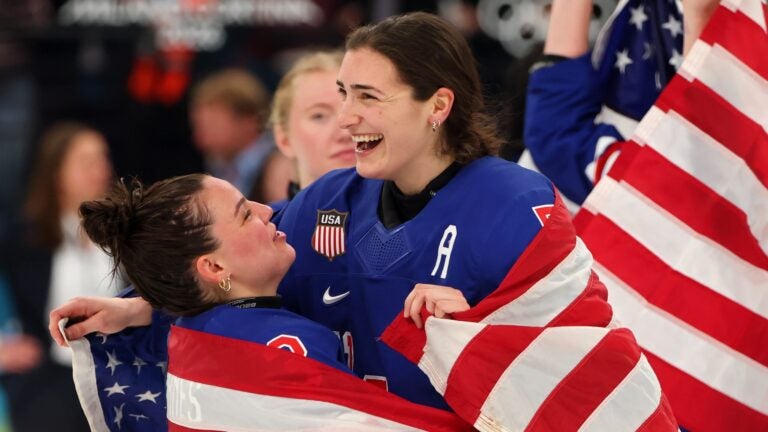

This was what the Boston Olympics were supposed to look like.
No, we don’t have the beautiful backdrop of the Dolomites, and we don’t have the high-speed rail to take us from South Station to Lake Placid, N.Y., for luge.
But this spread-out approach is exactly what Walsh believed New England could do had it continued with its bid to host the Summer Games. Boston had received the USOC’s blessing to pursue 2024, but it more likely would have been 2028 if the Olympics came to the region.
Walsh, the mayor of Boston from 2014-21 and now the executive director of the National Hockey League Players’ Association, was in Italy to watch hockey. It was his first time at the Olympics.
“I’ve had moments to reflect on it,” he told the Globe from the NHLPA’s headquarters at Santagiulia. “What we weren’t really prepared for was the next day. When we got the bids, we had a press conference at the Boston Garden the next day … We were, in some ways, very excited and shocked that we got the bid.
“Then, it kind of just got away.”
One thing that didn’t help Boston’s effort to host the Games was that Russia had just finished hosting in Sochi that winter. The headlines — the most expensive Olympics ever in a too-warm city, unfinished venues, and stray dogs ambling about the streets — didn’t leave a great impression on the public that the Olympics were a good idea.
“I think the thing that frightened everyone, and part of it was not being prepared for it, was signing the agreement,” Walsh said. “Everyone’s comparing it to Sochi. You can’t compare Sochi to Boston. You can’t compare Sochi to Italy.”
Walsh was struck by the number of locals he saw in Milan who had decided to, well, stay in Milan. The joke around the Olympics is that when your city hosts, you get out of there and rent your place out to make some extra cash. But everywhere you turned in Milan, the city was full — of Italians, of tourists, of Olympic fans.
“I look at people eating in restaurants and buying shops,” he said. “The revenue is coming.”
More than a decade after Boston withdrew its bid to host, Walsh still believes it would have been a good idea.
“Economically, it would have been huge to the region,” he said.
He pointed to the Olympic Village proposed for the former home of the Bayside Expo Center in Dorchester.
“The legacy was going to be 17,000-25,000 units of housing,” he said. “It’s 2026, and we have a developer for the area, and we don’t have a shovel in the ground.”
The one thing that Boston would have offered that Milan could not is centrality.
“If we had an Olympics, the center of Boston would be the focus of the Olympic Games,” he said.
Milan is too sprawling, with too many pockets of neighborhoods, to make it feel cohesive. American broadcasters chose the beautiful setting of the Duomo for their headquarters, but that wasn’t really where the action was centered. Instead, country hospitality houses were in hotels and venues all over, and the venues were all a 30-minute metro ride away from the Duomo plaza.
Boston’s size would have made the stretch from TD Garden to Newbury Street the center of the Olympics, even if there was soccer at Gillette Stadium, or canoeing in Western Massachusetts, or sailing in New Bedford.
The actual Games are important, but what they leave behind matters to a host more than the medals awarded. An Olympics would have provided Boston with deadlines — deadlines to prop up the MBTA, the oldest subway system in America. Deadlines to build and beautify. That’s exactly what Los Angeles is undertaking now as the focus shifts to 2028; the city has ambitious plans to build new transit systems to get around the horrendous traffic in the region.
But again, Walsh was so early in his tenure leading Boston that decisions had to be made, and finances — despite his promises that Boston 2024 would have been mostly privately funded — were top of mind for many in the city.
“That was a big sticking point,” he said. “I wasn’t going to risk the financial security of the city by signing that agreement.”
The next Games to be awarded will be Summer 2036. With Los Angeles on deck and Utah lined up for Winter 2034, it will probably be another generation before the United States gets back in the rotation. By then, who knows what model the Olympics might be following?
Walsh thinks it could have been different had he had a bit more time under his belt. It could have been Boston taking the torch last Sunday night in Verona, preparing to host the world’s largest sporting event in 29 months.
But too quickly the conversation got away from him and the organizers. They got the bid, then couldn’t figure out what to do next to make sure everyone back home saw the vision the same way they did.
“It’s like playing a sport,” Walsh said. “You can’t look ahead to the Super Bowl if you don’t win.”
Get the latest Boston sports news
Receive updates on your favorite Boston teams, straight from our newsroom to your inbox.
