


Local News
A judge ruled in favor of the city’s White Stadium plan earlier this year, but opponents appealed the decision.
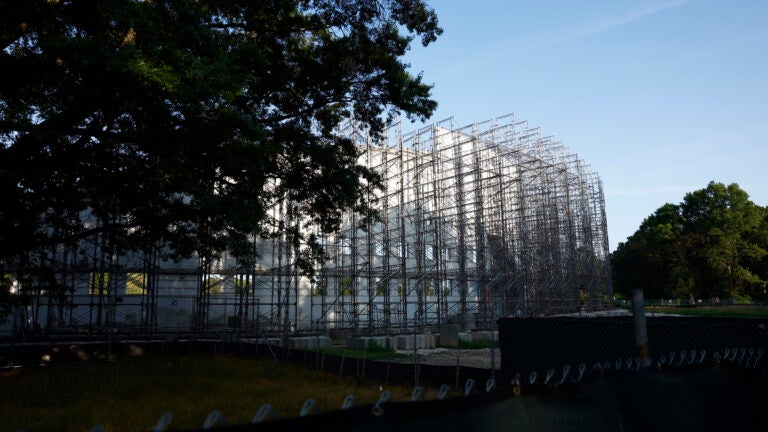
The legal battle over the contentious plan to redevelop White Stadium in Franklin Park is heading to the highest court in Massachusetts.
The plan, spearheaded by Boston Mayor Michelle Wu, involves a public-private partnership between the city and Boston Legacy FC, a new professional women’s soccer team. Together, the city and the team are preparing to spend hundreds of millions of dollars to build a new, state-of-the-art stadium that will be used by both the soccer team and Boston Public Schools students.
But opposition from some residents and others has been fierce and sustained. The Emerald Necklace Conservancy, a local environmental nonprofit, and a group known as the Franklin Park Defenders are at the forefront. Opponents sued the city, arguing that the project would violate state laws that cover the use of public parkland. After a trial earlier this year, a Superior Court judge ruled in favor of the city, allowing the project to proceed.
In October, opponents to the project filed an appeal brief with the Massachusetts Appeals Court. The case was officially added Wednesday to the docket of the Massachusetts Supreme Judicial Court. The conservancy praised the development.
“We are encouraged by the Supreme Judicial Court’s decision to take up the case, and we are hopeful for a decision that upholds Massachusetts’ constitutional protections for public recreation land and resources in all of its different varieties: in the heart of Boston and throughout the state,” Karen Mauney-Brodek, president of the conservancy, said in a statement.
Mauney-Brodek went on to advocate for a completely public version of the project, saying that there is still time to find an alternative home for Boston Legacy FC. The project’s opponents unveiled an alternate, fully public plan for the White Stadium redevelopment over the summer, saying that it would save the city millions while allowing BPS students to have total access to the new stadium. Boston City Council members and the local branch of the NAACP later expressed support for a formal review of the alternative plan.
The Wu administration has shown no interest in any alternative plans at this stage. The city and the soccer team signed a 10-year lease at the end of 2024, and demolition work is already complete. The city is now in the process of finalizing construction bids.
Construction will not be completed by March of next year, when Boston Legacy FC will play their debut game in the National Women’s Soccer League. The club announced that it will play the entirety of its first season at Gillette Stadium in Foxborough instead.
A spokesperson for the club said that it is eagerly anticipating a ruling by the SJC.
“Boston Public Schools students and the communities around Franklin Park have long deserved this kind of generational investment. We are proud to help deliver a modern venue for the entire city and remain confident in the trial court’s previous ruling in full support of the renovation of White Stadium. We look forward to the SJC’s final decision as construction continues,” the Boston Legacy FC spokesperson said in a statement.
The Wu administration also welcomed the news.
“Boston Public Schools student athletes have waited for decades for this state-of-the-art reconstruction. We are pleased that the SJC will make a final ruling while our construction proceeds,” a city spokesperson said in a statement.
The mayor has invested significant political capital in the project. Wu portrays it as a once-in-a-generation opportunity to support student athletes while also bringing in a private partner with pockets deep enough to help overhaul the dilapidated facility.
Boston Legacy FC will have the right to play up to 20 games per year in White Stadium, but there are “strict parameters” around when these can take place, according to the city. More than 90% of the stadium’s “programmable hours” will be used by BPS students and community groups. Concerns about a loss of green space, major traffic and parking disruptions, and a lack of public input are unfounded, the Wu administration says.
Opponents say that BPS students would still face significant disruptions, with football teams positioned to be the most affected. They worry about increased noise and light pollution, litter, and a fundamental change to Franklin Park’s historic character.
In court, they are arguing that the plan violates the Massachusetts Constitution, which requires that the state Legislature approve a change to the use of public park and recreation lands.
“The Emerald Necklace Conservancy, along with a concerned group of community leaders, citizens, and BPS parents, continue to be focused on protecting the Commonwealth’s public land protections, including the constitutional provision which declares that only a two-thirds vote of the state legislature can remove constitutional protections from protected park and recreation land,” Mauney-Brodek said.
The city and Boston Legacy FC have agreed to split the costs of the project evenly, but estimates have risen notably since the project was first unveiled. In the spring of 2024, the city set aside $50 million for its half of the construction costs. The most recent official cost estimate from the city came last December, with officials projecting a $91 million price tag. The estimates have increased due to global factors affecting construction costs as well as changes to the plan that were spurred by community feedback, according to the city.
Wu has been hesitant to release an updated estimate this year, saying that construction bids need to be finalized first. She has acknowledged that the costs will “likely” exceed the $91 million estimate, and said over the summer that an updated estimate would be released by the end of this year.
But now, the Wu administration is signaling that an estimate won’t come until “early 2026,” according to The Boston Globe. The city spent $12 million on demolition and site work, per the Globe, and it has so far designated $76 million to contractors.
Members of the Boston City Council, even those who generally favor the project, are growing frustrated with the lack of a new estimate. The body unanimously passed a resolution last week demanding more transparency.
Sign up for the Today newsletter
Get everything you need to know to start your day, delivered right to your inbox every morning.

