Local News
More density, new zoning, and fresh investment in affordable and social housing top his priorities.
Suzanne Kreiter/Globe staff
When newly elected Somerville Mayor Jake Wilson bought his first home in Winter Hill 21 years ago, he was terrified he was making a terrible mistake. He and his wife paid $425,000 for a modest starter home in the Winter Hill neighborhood, a house that had sold for $180,000 just six years earlier.
“That seemed like a ridiculous amount to pay for a relatively modest house in a non-wealthy community,” Wilson said. Yet what felt like a financial leap turned out to be one of the best decisions of his life.
Today, he doubts he could buy anything similar. “No,” he said. “So much has changed.”
Back then, Wilson said, working families still felt they could stretch and scrape together a nest egg and build a life in Somerville. “It doesn’t feel doable anymore,” he said.
That shift — families moving out, young people priced out, seniors unable to age in place — is why housing dominated his recent campaign, and why he says it remains the No. 1 issue residents raise with him.
Wilson still remembers the “neighborliness” that drew him here in the early 2000s, a feeling rooted in his Midwestern upbringing.
“I absolutely love this city,” he said. “I want to protect that feeling.”
Someverille’s unique challenges
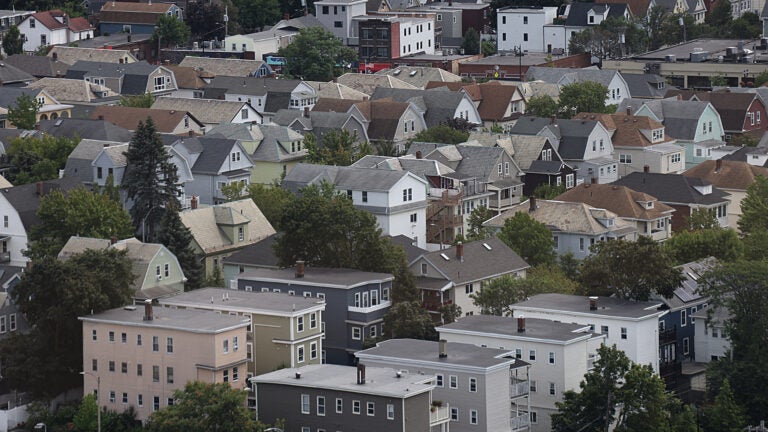
Somerville, the most densely populated city in New England, packs more than 80,000 residents into four square miles. Its housing stock is defined by early-1900s triple-deckers, multi-family homes, and a growing wave of renovated condos.
Amid the region’s housing crisis, Somerville has been adding homes faster than most other communities.
According to the 2025 Greater Boston Housing Report Card from Boston Indicators, the city added 2,046 units from 2020 to 2025 — a 5.6% increase, outpacing the region’s 3.8% growth.
But prices soared during the same period. The median single-family home jumped from $780,560 in 2015 to $1.3 million in 2025, a 67% increase. Condo prices rose from $703,451 to $900,000, an increase of 28%.
“I think the obvious change is the increase in prices,” said David Gibbs, executive director of the Community Action Agency of Somerville and a resident since 1998. Longtime owners have benefited, he said, but only if they sell. Meanwhile, about 67% of residents rent, and many would be unable to afford anything in the city if they lost their current housing.
“That’s just an enormous instability in our population,” Gibbs said.
He’s also seen a shift in what’s being built: a proliferation of high-end condos, whether through conversions or new developments.
“It’s a little hard to understand who’s living there and how they can afford it,” Gibbs said.
Statewide, permitting remains well below levels of past decades, with a recent slowdown. Still, Wilson says the city needs to keep pushing.
“We need to be building more housing as a region, as a nation,” Wilson said. “And Somerville needs to do our part.”
The fix
Wilson says Somerville needs to build more housing, specifically, more deeply affordable housing, to make a real dent in the crisis.
The Somerville 2040 Vision calls for 20% of the city’s housing to be affordable, but even with the city’s 20% inclusionary zoning requirement, Wilson said, “mathematically, that doesn’t happen.”
He pointed to the 299 Broadway project at the former Star Market site as an example of what’s possible. The development will include 288 units, with 132 affordable at 30% and 60% AMI (area median income), many of them two- and three-bedrooms.
“That’s a game changer,” Wilson said, noting it was only possible through multiple partnerships and grants.
Other projects are also in the pipeline, including 24 Webster (43 affordable units) and the Clarendon Hill redevelopment, which will bring 591 units across public housing, affordable, and market-rate tiers.
Despite a broader construction slowdown, he said, developments are happening.
The city is also updating its affordable housing overlay and pushing for more density near the new Green Line Extension stations.
While new housing comes online, Wilson wants to stabilize rents.
Residents need reassurance “that they’re not going to get hit with a 40% hike,” he said.
He’s watching the statewide ballot question on rent stabilization, which would cap annual rent increases at 5% or the cost-of-living rate, with exemptions for owner-occupied buildings with four or fewer units and for new buildings for their first 10 years.
Finally, Wilson is exploring ways to expand social housing, which is permanently affordable homes owned by public or nonprofit entities and built to serve residents, not investors.
Will all of this be enough?
Members of Somerville YIMBY (Yes In My Backyard) are hopeful that Mayor Wilson will tackle the city’s housing shortage.
“More housing is good. Affordable housing is great,” said Josh Michel, a member of the group’s Steering Committee. “The question is, who pays for it?”
That often falls to the developers, Michel added.
However, “We need to build permanently affordable housing, because the structure of the market at the moment has failed us, and as costs are going up.”
Michel noted that while Wilson often cites the 299 Broadway project, developments with nonprofits and state support remain rare.
The first big test will be the 26-story tower proposed in Davis Square by Copper Mill, which would include 502 units with 20% set aside as affordable.
“Can he withstand the pushback and stick to actually getting affordable housing built?” Michel asked.
YIMBY emphasizes a multi-pronged approach, echoing Wilson’s focus on affordable and social housing, as well as on rezoning.
“I often say there’s no one trick to this,” said Aaron Weber, another Steering Committee member. “You cannot get rid of belly fat or a housing crisis with just one thing. It’s going to take a lot of things.”

Sign up for the Today newsletter
Get everything you need to know to start your day, delivered right to your inbox every morning.