


National News
Workers are demanding more robust staffing levels and higher pay. The strike comes three years after a smaller job action won significant gains.
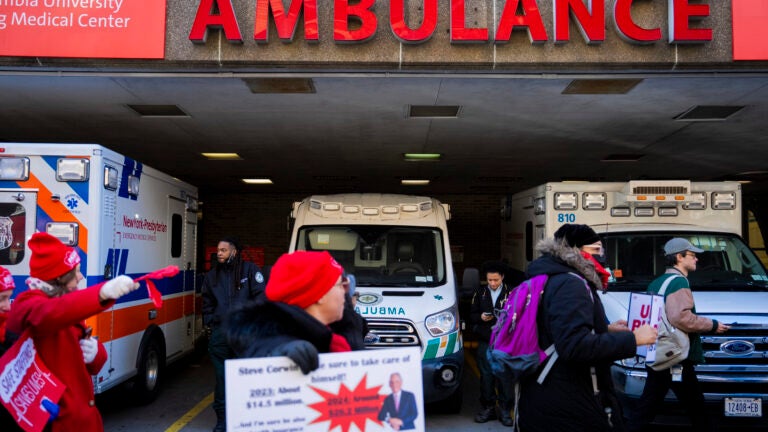
NEW YORK — Nearly 15,000 nurses went on strike Monday at some of New York City’s top hospitals, setting the stage for what could be one of the biggest labor showdowns in the city’s health care industry in decades.
The union representing the nurses says a strike is necessary to force hospitals to ensure minimum staffing ratios so nurses aren’t overwhelmed with too many patients. They are also demanding higher wages and more security at hospitals to reduce violent episodes and shootings.
The strike is targeting some of the city’s leading medical institutions: NewYork-Presbyterian/Columbia, Montefiore Medical Center and the main campus of Mount Sinai Hospital along with two other major hospitals within the Mount Sinai system.
Gov. Kathy Hochul signed an executive order Friday declaring that “a disaster is imminent” and that the strike was likely to “impact the availability and delivery of care, threatening public health.”
For weeks, hospital executives had been preparing to keep hospitals running and medical care accessible in the event of a strike. They secured contracts with staffing agencies to provide travel nurses and reserved hotel rooms for them, according to officials at the Greater New York Hospital Association, a trade group.
Some hospitals canceled scheduled surgeries and accelerated discharges during the weekend to reduce patient counts because of the prospect of a strike. The affected hospitals arranged to transfer infants out of their neonatal intensive care units to units elsewhere, according to Elisabeth R. Wynn, an executive vice president at the hospital association.
The state Department of Health on Saturday instructed hospitals not affected by the strike to be prepared to accept patients from the affected medical centers. The letter makes it clear that hospitals where nurses are on strike are free to transfer patients, even against the patients’ will.
About 7,000 nurses at Mount Sinai, in Manhattan, and Montefiore, in the Bronx, went on strike three years ago. That time, the biggest issue for the nurses was chronic understaffing of units, which nurses said left them with too many patients to care for safely. The strike ended after three days when the hospitals agreed to hire more nurses and to set minimum staffing ratios with a strict enforcement mechanism. In the years since, the nurses’ union has been able to win payouts for its members when hospitals left units understaffed.
But nurses say that they need to strike now because hospitals are trying to erode some of those protections related to minimum staffing levels.
“Wealthy hospitals are trying to undo the safe staffing standards we won for our patients when we went on strike three years ago,” Nancy Hagans, the president of the nursing union, the New York State Nurses Association, said Saturday.
Three years ago, nurses also won significant raises, boosting minimum pay nearly 20% over three years, and propelling starting pay well above $100,000.
At Montefiore, pay for starting nurses is $119,423, and the average base salary for nurses — many of whom have years of experience — is about $165,000, according to figures provided by the hospital.
The last strike unfolded when the coronavirus pandemic still felt recent. Many New Yorkers remembered banging pots and pans and cheering from their windows at 7 p.m. each day in gratitude for nurses and other health care workers.
There was a widespread sense that some hospitals had done too little to prepare for the pandemic, leaving some nurses to fashion protective gear out of garbage bags in the deadly first wave in March 2020. And hospitals were buoyed by federal pandemic bailout money.
But the dynamics this time could turn out to be different. Hospitals are expecting lean years ahead, as many New Yorkers lose health insurance and billions of dollars in federal care health funding to the state start to dry up, the result of the domestic policy law President Donald Trump signed in July.
“The health care system is under siege financially,” said Kenneth E. Raske, the president of the Greater New York Hospital Association. “The demands of the union are so outrageous that there is no way they can concede to what the union is asking for.”
Lucia Lee, a spokesperson for Mount Sinai, said that nurses at the hospital make on average $162,000 — and that the union’s salary demands would increase that to $275,000 over three years.
Officials with the New York State Nurses Association, however, said that Mount Sinai and the other hospitals were offering only about $4,500 more a year.
Nursing union officials, meanwhile, point to the multimillion-dollar salaries of hospital executives. The head of NewYork-Presbyterian, Dr. Steven Corwin, for instance, received more than $26 million in compensation in 2024, some of which related to retirement funds and bonuses deferred from years before, according to a public filing. A spokesperson for the hospital declined to comment on Corwin’s salary.
“While NewYork-Presbyterian, Montefiore and Mount Sinai — three of New York City’s wealthiest private hospitals — are claiming they can’t afford to settle a fair union contract that keeps nurses and patients safe, they likely have plenty of cash on hand to use to fight their own workers,” Hagans said.
Nurses cite workplace safety concerns as another reason they are striking. Hospitals across New York have been the site of shootings or threatened shootings in recent years, and some nurses have been troubled by the lack of metal detectors and other measures to screen weapons at some hospital entrances.
On Thursday at NewYork-Presbyterian Brooklyn Methodist Hospital, a man cut himself with a makeshift knife and barricaded himself in a blood-spattered room with a patient and a security guard. He was killed after police said he had rushed them with the weapon.
This article originally appeared in The New York Times.
Sign up for the Today newsletter
Get everything you need to know to start your day, delivered right to your inbox every morning.

