


Boston Bruins
“We did it. We’re a part of that history. No one could ever take it away from us.”
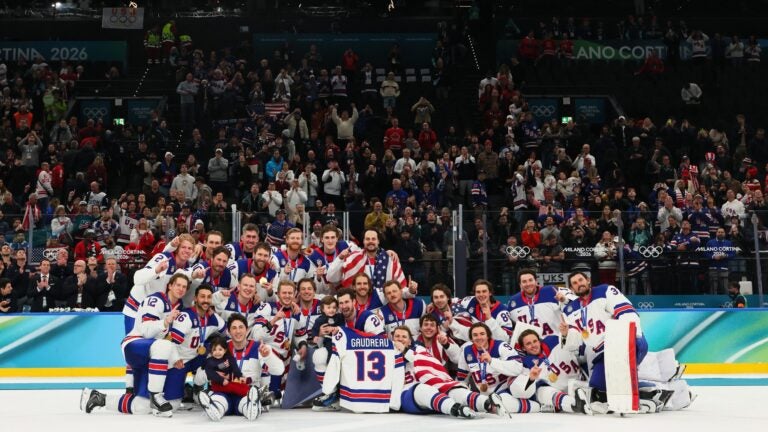
For the first time since the “Miracle on Ice” in 1980, the U.S. men’s ice hockey team finally has Olympic Gold in its grasp.
In one of the most anticipated hockey games in decades, the U.S. outlasted Canada in an instant classic in Milan — with Jack Hughes scoring the golden goal in 3-on-3 overtime to secure a dramatic 2-1 win over their greatest rival.
“This is all about our country right now,” Hughes said postgame, per ESPN’s Emily Kaplan. “I love the USA. I love my teammates. It’s unbelievable. The USA Hockey brotherhood is so strong.”
Connor Hellebuyck was stellar in net for Team USA, stopping 41 shots in a redepemptive performance for both himself and the Americans after falling short in the 4 Nations Face-Off Final in Boston last February.
The U.S. is leaving the 2026 Winter Games in Milan-Cortina with its third gold medal in men’s hockey — etching itself in hockey history alongside both the 1960 and 1980 rosters.
Here are nine takeaways from an instant classic in Italy:
USA finally reaches hockey summit once again
As easy it might be to draw parallels between this 2026 Olympic squad and the “Miracle On Ice” crew that inspired a nation — the fact that both gold-medal triumphs played out on Feb. 22 (46 years apart) should be where the connections start and stop with these two teams.
This wasn’t a lovable crew of collegiate-level underdogs tasked with the seemingly unsurmountable endeavor of toppling the Soviet Union.
The 2026 U.S. men’s ice hockey roster was arguably the greatest roster the program has built — the culmination of years of homegrown hockey development that has led to hockey superstars like Auston Matthews, the Hughes brothers, Tkachuk brothers, Jack Eichel, and others all thriving in the NHL.
It seemed all but inevitable that the path to a gold medal was going to have to go through Canada — hungry to defend its crown as the premier authority on the game it cultivated over a century ago.
But after playing second fiddle to Canada over several other failed clashes — be it on the Olympic stage in 2002 and 2010 or during 4 Nations last year — U.S. head coach Mike Sullivan preached the opportunity in front of the Americans entering Sunday’s showdown in Italy.
“The history of the sport is important, and in particular, in this instance, the history of American hockey is important,” Sullivan said, per Michael Russo of The Athletic. “We tried to bring it to their attention, because I think what it does is it heightens the opportunity that we have. It’s a privilege to be here. It’s an honor to represent your nation. I know these guys take it very seriously. …There’s been two gold medals.
“The first medal was in 1960; there were 16 players on the roster — two goalies, four defensemen, 10 forwards. In 1980, there were 20 players on the roster. So when you think about it in those terms, there’s 36 American-born hockey players that have gold medals. What an incredible opportunity we have in front of us.”
And on Sunday, the Americans seized said opportunity.
No more second place. No more silver medals.
For the first time in decades, U.S. hockey is holding court atop the summit of the sport.
For a tight-knit team that had bonded over the through, tragedies, tears, trials, and triumphs — the sight of the stars and stripes raised high above the ice was the end result of a years-long journey.
“Sully talked it about right away, as soon as we got here, that there was the ’60 team, the ’80 team, so 34 guys total in all of USA Hockey history to win a gold medal,” Charlie McAvoy told The Boston Globe. “That’s what we were playing for. And [expletive], man, two weeks later, we did it.
“We did it. We’re a part of that history. No one could ever take it away from us. This group’s gonna walk together forever. I’ve never been so proud in my life.”
Hughes, Hellebuyck the heroes for Team USA
Entering the Olympic tournament, most of the press surrounding a stacked American roster seemingly revolved around the U.S.’s superstar forwards like Auston Matthews and bombastic antagonists like Matthew and Brady Tkachuk.
But if Team USA wanted to overcome an uber-skilled Canada roster, it was going to need to rely on its goaltending, defensive fortitude, and depth to secure a gold medal.
Look no further than the top stars on Sunday, with Hellebuyck doing his part to clinch the Americans’ first gold in 46 years.
Tasked with trying to slow down Canada’s high-powered offense, Hellebuyck answered the call — turning aside several breakaways and Grade-A stops as his teammates routinely found themselves on the ropes.
It was a legacy-defining game for the 32-year-old netminder, who made the save of the tournament with a goal-saving paddle stop against Devon Toews while also shutting down a pair of breakaways from Connor McDavid and Macklin Celebrini.
Despite having a Hart Trophy and three Vezina Trophies on his resume, the knock against Hellebuyck has been his inability to deliver in the Stanley Cup playoffs for Winnipeg — including getting pulled three times in the first round of the 2025 postseason against St. Louis.
Those narratives should quiet down somewhat after his performance between the pipes in Milan.
“He channeled his Jimmy Craig tonight,” McAvoy told The Boston Globe of his goalie.
While Hellebuyck stood tall, Team USA also negated Canada’s potent power play — stymying a 5-on-3 sequence for 1:33 on Sunday and ending the tournament with a perfect 18-for-18 showing in shorthanded situations.
Bottom-six foot soldiers like Dylan Larkin, Vincent Trochek, and J.T. Miller delivered under those taxing minutes, while blueliners like Charlie McAvoy, Brock Faber, and Jaccob Slavin did what they could to try and slow down Canada’s high-octane attack.
And in crunch time, it was Team USA’s third-line forward in Jack Hughes who delivered. Just two games after his brother, Quinn, won a knockout-round game against Sweden with an OT winner, it was Jack who tallied the golden goal.
Defenseman Zach Werenski started the sequence by wrestling the puck away from Canada’s Nathan MacKinnon, giving him time to feed the puck across the slot to Hughes. Hughes — his mouth still bloodied and teeth chipped after taking a high-stick to the mouth in the third period — beat Jordan Binnington at 1:41 of OT to secure the victory for the U.S.
After a quiet showing during 4 Nations last year, Jack Hughes led all U.S. forwards with four goals and seven points in six games this tournament. The only American skater with more points? His brother, Quinn, who finished with eight points.
“He’s a freaking gamer. He’s always been a gamer,” Quinn Hughes told ESPN. “Just mentally tough, been through a lot, loves the game. American hero.”
Millis native Matt Boldy opens the scoring
Canada largely controlled play in the offensive zone through the first 10 minutes of action, holding a 6-2 edge in shots and testing Connor Hellebuyck in the early going. It took six minutes of action for Millis native and former Boston College standout Matt Boldy to land the first shot on goal for Team USA.
The 24-year-old forward made the most of that chance — with his attempt slipping past Binnington to give the Americans a 1-0 lead.
While skating into the offensive zone, Boldly flipped the puck past Canada’s D pairing of Cale Makar and Devon Toews — splitting between the duo and breaking in alone against Binnington. The skilled forward tucked the puck past Canada’s netminder to finally break the ice and put Team USA in front.
As captured by WBZ’s Kyle Bray, The Catman Cafe in Mansfield — where Boldy’s mother works as a bartender — was fired up after Boldy lit the lamp.
Team USA had another prime opportunity to double its lead at the end of the first period after Brock Nelson drew a penalty against Shea Theodore. But the Americans couldn’t put another puck past Binnington on the man advantage, with U.S. captain Auston Matthews passing up a Grade-A attempt in the slot.
Makar finally beats Hellebuyck after stout second period
As stout as Team USA’s D corps has been so far during Olympic play, it was all but inevitable that a Canada roster anchored by the likes of McDavid, Nathan MacKinnon, Makar, Celebrini, and others was going to make a major push in the offensive zone.
The second period was decidedly tilted in Canada’s favor, as they held a 19-8 edge in shots on goal over those 20 minutes of action.
Despite that lopsided shot total, Hellebuyck and Team USA largely limited the damage — with Team USA’s netminder turning aside a McDavid breakaway before both Jake Guentzel and McAvoy were sent to the sin bin.
Tasked with slowing down a Canada 5-on-3 opportunity for 1:33 of game action felt like a losing cause for the Americans. But a pair of key stops from Hellebuyck against Celebrini and several critical clears allowed the U.S. to negate the extended man advantage for Canada.
But as Canada continued to ramp up the pressure in the offensive zone, the gold-medal favorites finally broke through with 1:44 to go until the second intermission.
After a faceoff win from Bo Horvat, Makar snapped a puck that hugged the far post — beating Hellebuyck and knotting the game up at 1-1.
Team USA nearly had the perfect counter after a shot from defenseman Brock Faber beat Binnington — but the puck rang off of a pair of posts and out of danger.
Hellebuyck stands tall to force OT — and a win
Canada’s offensive onslaught continued in the third period, with Hellebuyck once again serving as the great equalizer.
Team USA’s top goalie made the save of the tournament early in the third — denying a point-blank attempt from Toews with a paddle stop before later turning aside another breakaway bid from Macklin Celebrini.
McAvoy also denied a goal after blocking a deflected shot from Tom Wilson that slipped behind Hellebuyck amid a scrum.
While largely treading water for most of the second half of regulation, the Americans did receive a major break.
After Team USA avoided a call for too many men on the ice, Canada forward Sam Bennett was assessed a double-minor penalty after drawing blood against Jack Hughes with a high stick.
Despite getting four minutes on the power play, the U.S. wasn’t able to generate much against Binnington — with that extended man advantage ended early after Jack Hughes was also whistled for a high stick.
That late Canada power play led to another Grade-A shot from Celebrini, which was turned aside by Hellebuyck and the Americans.
After 60 minutes of play, Canada held a 40-25 edge in shots on goal. A gold medal was going to come down to 3-on-3, sudden-death hockey.
It didn’t take long for Hughes and the Americans to deliver the dagger — and spill out onto the ice in complete revelry.
Team USA honors memory of Gaudreau
As the U.S. players celebrated on the ice, the team made sure to celebrate the memory of Johnny Gaudreau amid their Olympic triumph.
Gaudreau — a longtime U.S. hockey standout and All-Star player in the NHL — was tragically killed alongside his brother, Matthew, in August 2024 while biking in their native New Jersey on the eve of their sister’s wedding.
During Sunday’s celebration, Auston Matthews, Zach Werenski and Matthew Tkachuk skated around the rink holding Gaudreau’s No. 13 USA jersey.
Both Tkachuk and Werenski — both of whom played with Gaudreau in Calgary and Columbus, respectively — then brought two of Gaudreau’s children, Noa and Johnny Jr., onto the ice for the team photo.
The entire Gaudreau family was in attendance for Sunday’s victory, with Sunday also standing as Johnny Jr.’s second birthday.
“It meant everything,” Werenski told Stephen Whyno of the Associated Press. “This is something John would have been at. And to see his family here supporting us and seeing his kids, bringing them on the ice, we talked about playing for him, making him proud and I think we did that. Super special to see them and to have kids on the ice, he was a huge part of USA Hockey.”
“This is for the guys who wore this jersey before us,” Larkin added. “All those people should be here. Johnny especially, Matty his brother. To get it done today, it’s just an unbelievable feeling.’’
Two Bruins win gold
Two Bruins skaters are heading back to Boston with some gold hardware in McAvoy and Jeremy Swayman.
McAvoy — tasked with being the U.S.’s go-to defensive equalizer on the team’s top D pair with Quinn Hughes — played heavy minutes throughout the tournament and doled out some painful hits in knockout-round play against Sweden and Slovakia.
While Hellebuyck often served as the last line of defense of the U.S., it was McAvoy who kept the game knotted at 1-1 in the third period by batting down Wilson’s fluttering attempt while situated behind the American netminder.
Swayman saw action in just one game during group-stage action — allowing three goals (including a tally from the red line) and sporting an .857 save percentage in a win over Denmark.
Elsewhere, both Joonas Korpisalo and Henri Jokiharju earned bronze medals for Finland, while longtime Bruin and former Boston captain Brad Marchand won silver in his first Olympic tournament with Canada.
The 37-year-old Marchand finished with zero goals and one assist in four games for Canada.
Canada misses Crosby’s presence
After Team USA fell short against Canada in the 4 Nations Face-Off final without both Quinn Hughes and Charlie McAvoy in the lineup, Canada was forced to take to the ice without its captain on Sunday.
Canada center Sidney Crosby didn’t get the green light to play after suffering a lower-body injury during the quarterfinal round against Czechia. After missing Canada’s semifinal round against Finland, the 38-year-old Crosby was deemed as a “game-time” decision by Canada head Jon Cooper.
“Imaging revealed that Crosby avoided the worst-case scenario with his injury, sources told ESPN. Crosby did everything he could to return to the tournament, including consulting with several experts on hand in Milan,” ESPN’s Emily Kaplan wrote. “Sources said it had been trending in the right direction for Crosby to play in the gold medal game.”
Even at his age, Crosby is still one of the top players in the NHL and arguably the most respected player in hockey today. His presence for Canada was missed, especially as a seasoned veteran with a pair of Olympic gold medals (as well as the golden goal in 2010) on his resume.
”You feel bad letting a guy like that down,” Marchand said of Crosby, per The Boston Globe. “Just one of the best ever to play, one best leaders to ever play the game. Wish we could have got it done for him.“
Plenty of local ties
Beyond the Bruins’ representation on Team USA, there were several other players and coaches with ties to Massachusetts who secured their first Olympic Gold Medal.
Millis product and former BC forward Boldy made a major impact on Sunday, but North Chelmsford native and former BU star Jack Eichel also served as the U.S.’ top-line center for the entire tournament — finishing with six points over six games.
Defenseman Noah Hanifin (three points in six games) hails from Norwood and played for Boston College for one season.
There were several other players on Team USA with links to the Commonwealth due to their collegiate teams. Winger Brady Tkachuk, forward Clayton Keller, and goalie Jake Oettinger all went to Boston University, while Hellebuyck played two seasons at UMass Lowell.
All four of Team USA’s coaches also all hail from New England. Head coach Mike Sullivan is a Marshfield product and BU alum who both played for and coached the Bruins over the course of his pro-hockey career.
Fellow assistant coaches John Hynes (Warwick, Rhode Island) and Davis Quinn (Cranston, Rhode Island) also played at BU, while John Tortorella is from Boston.

Get the latest Boston sports news
Receive updates on your favorite Boston teams, straight from our newsroom to your inbox.
