


Sports News
Somehow, Tom Brady will also be there.
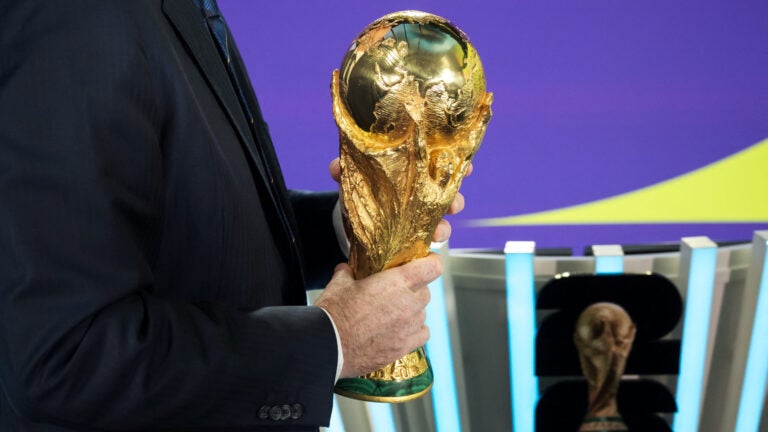
One of the most important events in the buildup to the 2026 FIFA World Cup will take place on Friday, as qualified teams learn their group stage opponents.
The tournament, which will be co-hosted by the United States, Canada, and Mexico, will include an unprecedented 48 teams when it kicks off June 11.
Friday’s “Final Draw,” which will be held at the John F. Kennedy Center for the Performing Arts in Washington, D.C., at noon, will be star-studded. The culmination will be the sorting of qualified teams into 12 groups.
How does it work?
The 48 teams (including six spots for teams still going through qualifying playoffs) have been divided into four “pots” for seeding purposes. The pots (listed below) were determined by FIFA ranking aside from the host nations, which were automatically assigned to Pot 1.
FIFA has certain restraints on the draw, ensuring that no group has more than one team from each confederation. The exception to this is UEFA (the European conference), which has 16 entrants in the field. However, no more than two UEFA teams will be drawn into a single group.
The host nations have already been assigned to their groups: Mexico in Group A, Canada in Group B, and the US in Group D. Historically, World Cup hosts have been placed into Pot 1 in order to help provide a potentially friendlier path in the tournament.
When the draw begins, the four pots containing 12 balls each will be placed on stage (each with the name of a qualified nation printed on a piece of paper folded inside the ball).
Each host country will be drawn first, denoted by a nation-specific color. After the three hosts have been officially assigned to their groups, the rest of Pot 1 (assigned identical color balls) will be drawn. One additional stipulation is that per FIFA’s aim to “ensure competitive balance,” the top four overall ranked teams in Pot 1 (Spain, Argentina, France, and England) will be split up to ensure that — should each of the four win its group — they will not meet before the semifinals.
Following Pot 1, the draw will proceed through Pots 2-4 until four teams have been assigned to each group. For complete details on the draw, you can sift through FIFA’s official procedures.
Which countries will be in the draw?
Pot 1: Canada, Mexico, US, Spain, Argentina, France, England, Brazil, Portugal, Netherlands, Belgium, Germany.
Pot 2: Croatia, Morocco, Colombia, Uruguay, Switzerland, Japan, Senegal, Iran, Korea Republic, Ecuador, Austria, Australia.
Pot 3: Norway, Panama, Egypt, Algeria, Scotland, Paraguay, Tunisia, Côte d’Ivoire, Uzbekistan, Qatar, Saudi Arabia, South Africa.
Pot 4: Jordan, Cape Verde, Ghana, Curaçao, Haiti, New Zealand, European Play-Off A, B, C, and D, FIFA Play-off Tournament 1 and 2.
Can other nations still qualify?
While 42 nations have punched their tickets, six spots are still up for grabs. A total of 22 nations still have paths to qualify, with competitions to determine the spots set for March 2026.
Two will emerge from the Play-Off Tournament and four through European Play-Off matches.
The European countries still in the mix: Albania, Bosnia and Herzegovina, Czechia, Denmark, Italy, Kosovo, Northern Ireland, North Macedonia, Poland, Republic of Ireland, Romania, Slovakia, Sweden, Türkiye, Ukraine, Wales.
From the Play-Off Tournament: Bolivia, Congo, Iraq, Jamaica, New Caledonia, Suriname.
What does it mean for the US team?
The US already is assigned to Group D via Pot 1. As a result, it can’t be drawn against the likes of Argentina, Spain, or other traditional powerhouses. However, plenty of talented teams await in the other pots, with even four-time champion Italy potentially lurking in Pot 4 (should it qualify).
When will we know which teams are coming to Boston?
Despite the draw taking place on Friday, the full schedule won’t be released until approximately 24 hours later. This, FIFA has said, “aims to ensure the best possible conditions for all teams and spectators while, where possible, enabling fans all over the world to watch their teams play live across different time zones.”
Gillette Stadium, which FIFA is labeling “Boston Stadium” for the World Cup, will host seven matches. Five will be group stage games, taking place from June 13-26. Foxborough will then host two knockout stage games: A Round of 32 match on June 29, and a quarterfinal on July 9.
Who will be at the Final Draw?
Given the World Cup’s popularity, it’s no surprise that the event will not only include the presence of international soccer stars past and present, but also a few recognizable US athletes for those less familiar with the world’s game.
Kevin Hart, Heidi Klum, and Danny Ramirez will be co-hosts, with Eli Manning as the red carpet host.
FIFA also announced that Tom Brady, Shaquille O’Neal, Wayne Gretzky, and Aaron Judge will serve as “draw assistants,” with the draw itself “conducted” by broadcaster Samantha Johnson and former England center-back Rio Ferdinand.
There also will be live performances from Andrea Bocelli, Nicole Scherzinger, Robbie Williams, and the Village People.
Get the latest Boston sports news
Receive updates on your favorite Boston teams, straight from our newsroom to your inbox.

