


Politics
Mayor Michelle Wu said that Boston will be a “beacon” for the country over the next four years.
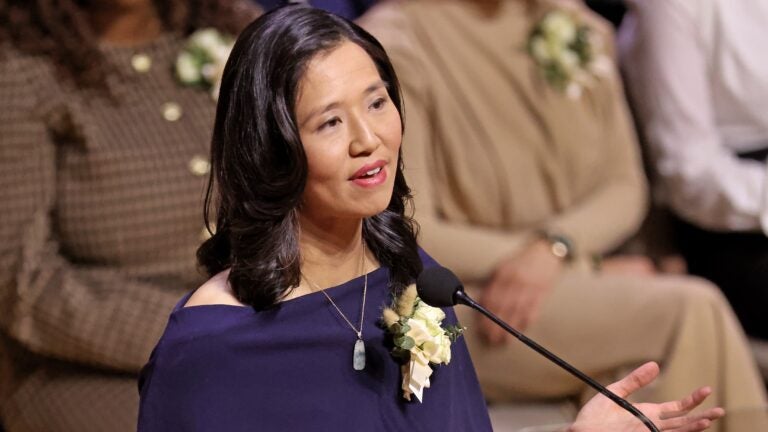
Boston Mayor Michelle Wu was sworn in for her second term Monday, taking the stage inside Boston Symphony Hall to tout her administration’s accomplishments over the past four years and to lay the groundwork for the next four.
On the precipice of the nation’s 250th anniversary, Wu delivered an inaugural address steeped in the history of the American Revolution. She framed the city’s current work as a continuation of that original fight, casting Boston as a beacon of social connection in an era of isolation and as a bastion of democratic values under a federal government that sullies them.
“Today, the forces we face aren’t British troops on the Common or ships in our harbor, but they demand no less ingenuity. Isolation, polarization, and misinformation are fraying our connection to trust, truth, and each other,” Wu said. “Core industries are losing workers to competitors overseas, and against this backdrop, the federal government is taking aim at the ways we take care of each other.”
To reinforce the foundations of American democracy, Wu said that her administration will put more resources into getting “the basics” right. City services will become more efficient and responsive, Wu said, and she will focus on building trust in city government through actions like holding “mayor’s office hours” events across Boston this year.
“We’re going to streamline every city permitting process and set the bar for excellence in constituent services,” she said.
The mayor reiterated her goal of making Boston Public Schools the best public school district in the country. She remains committed to “right-sizing” the district, a process that necessitates a number of school closures. This has drawn some backlash from BPS families and staff members, as well as concerns about a lack of transparency from the City Council.
Wu said that BPS will “revisit school assignment to be simpler and more predictable” and improve transportation so students spend less time on the bus. Every BPS school will have quality before and after school programs by the beginning of the 2027 school year, she said. Wu also mentioned how the Massachusetts School Building Authority recently gave its initial approval for a rebuild of Madison Park Technical Vocational High School that could cost as much as $700 million.
Wu kept up her support for the White Stadium redevelopment, which she said will become the best student athletics facility in any public school district in the country. That plan has drawn loud opposition from some environmental advocates and residents. The price tag of the White Stadium project increased notably since it was first unveiled, and Wu has been hesitant to release updated cost estimates. Construction bids are now being finalized, even as an ongoing legal battle heads to the state’s highest court.
In her first term, Wu said that the city built some 4,200 new affordable housing units and that there are another 2,000 under construction. Boston will continue to convert vacant lots and office buildings into housing, she said. Housing investments are necessary to keep residents from leaving the city, and the mayor signaled that she wants to explore new ways to use “public planning, public finance, and public land” to create more housing.
As Wu coasted to reelection last year, she maintained a continuously antagonistic relationship with the Trump administration. She used her address to blast the federal government for a range of actions, from “unconstitutional military campaigns” to economically harmful trade wars and the deployment of National Guard troops in multiple American cities. She spoke about federal agents “abducting” residents and said that the city would stand up to fight against the Trump administration’s efforts to slash funding for higher education institutions.
Wu sought to project righteous patriotism throughout her address. She began and ended the speech by talking about Henry Knox, a Revolutionary War general known for moving artillery from Fort Ticonderoga to Boston. Knox’s bold moves are illustrative of the core theme of her address: that progress takes courage.
To hammer this home, Wu took language directly from the Declaration of Independence and gave it her own spin.
“When, in the course of human events, it becomes necessary for a city to stand as the beacon for freedom and proof of what’s possible, a testament to the endurance of American ingenuity and civic success, Boston will be that beacon,” she said.
Sign up for the Today newsletter
Get everything you need to know to start your day, delivered right to your inbox every morning.

